[FAQ] Thermal Pad Selection Guide: All Grades at a Glance
2026.10.29 14:06:0
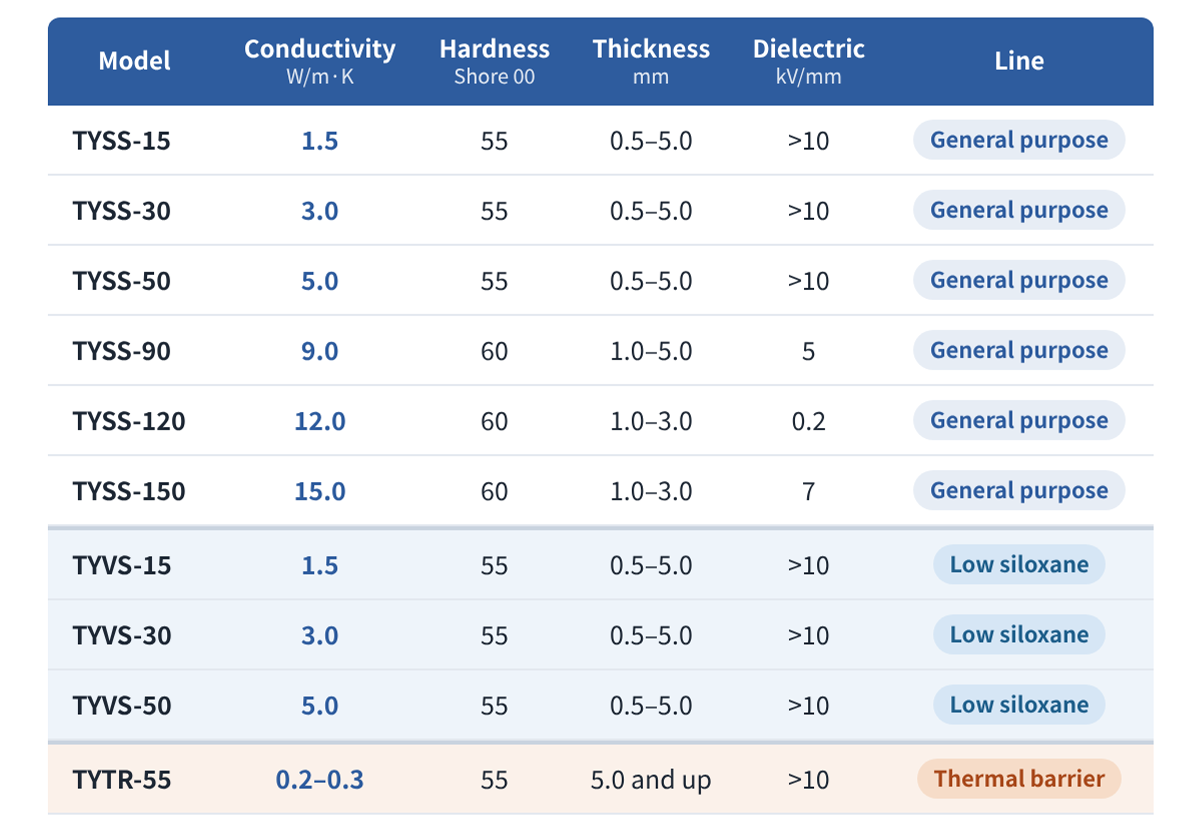
When a customer print calls out a thermal pad, a die-cutter or converter has to find a material that matches on thermal conductivity, hardness, thickness & insulation. On top of that, it has to run clean on their own press and tooling. Comparing candidates one by one takes time. So we put every 3CTY thermal pad grade on one page to help you narrow down the options fast.
How do the 3CTY thermal pads compare?
All grades are UL94 V-0 and RoHS & REACH compliant. TYSS & TYVS run from -40 to 200°C. Thermal conductivity is tested to ASTM D5470, hardness to ASTM D2240 and dielectric strength to ASTM D149.
How do you read the spec table? Thermal conductivity shows how well the pad moves heat. Higher grades suit parts that run hotter, but real-world performance also depends on thickness and how well the pad contacts both surfaces. See "[NOTE] How to Check Thermal Conductivity" for more. Hardness shows how soft the pad is. The lower the value, the better it conforms to uneven surfaces, and the less pressure it needs to compress, which means less stress on components. Thickness is chosen to fit the gap between the component and the heat sink. A pad slightly thicker than the gap, compressed into place, fills it with no voids.
Dielectric strength is the voltage the pad can withstand without conducting, per 1 mm of thickness. If the pad touches live electrical parts, choose a grade with a high value.
TYSS, TYVS or TYTR — which line fits the job? TYSS is our general-purpose silicone thermal pad. It has the widest conductivity range, 1.5 to 15 W/m·K, and covers most heat dissipation jobs: electronics, battery packs, LED, semiconductor equipment & EPCU. TYVS keeps low molecular siloxane (ΣD3–D9) under 100 ppm. Pick it where silicone outgassing could fog a lens or contaminate an electrical contact: cameras, optical modules, sensors & relays. Read more in "[FAQ]What is the Difference Between TYSS and TYVS?". TYTR works the other way. It blocks heat instead of moving it, slowing thermal propagation between battery cells. With a 3 mm pad compressed at 1.5 bar and one side heated to 450°C, the other side reached 149°C after 20 minutes. At 650°C it reached 210°C. Full test data is on the TYTR product page.
Looking to replace the pad you use today? Cost or supply concerns often lead teams to look for an alternative material. Send us the part number or datasheet of the pad you use now. We'll compare it on thermal conductivity, hardness, thickness & dielectric strength and come back with the closest 3CTY grade and its TDS. We match on published specs, and the final call is made after your own evaluation.
What format do the pads come in? Grades up to 5 W/m·K come in 200×400 mm sheets, and higher grades in 200×200 mm sheets. If you'd rather skip a process step, we also supply pre-cut shapes. See "[FAQ]Thermal Pads in Various Shapes" for what we can make.
Thickness runs from 0.5 to 5.0 mm (TYSS-90 from 1.0 mm, TYSS-120 & 150 from 1.0 to 3.0 mm). You can choose a release liner on both sides or on one side, whichever suits your process.
Want to test it on your own press? The surest way to judge a pad is to run it on your own press. We'll recommend the right product after a quick consultation and, where it makes sense, provide free samples after an internal review. Tell us the thickness & application and we'll pick the right grade for you.
Need help choosing a thermal pad or want free samples? Contact us anytime.

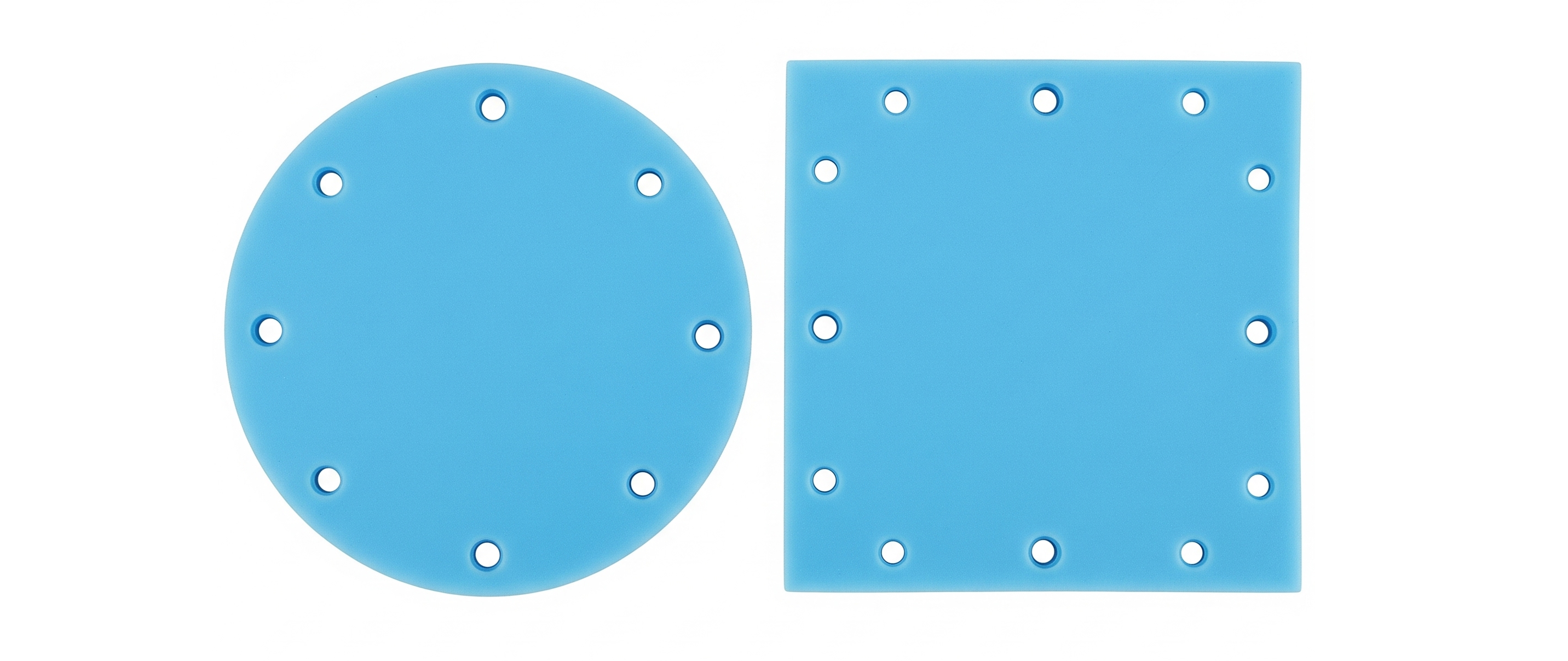 Grades up to 5 W/m·K come in 200×400 mm sheets, and higher grades in 200×200 mm sheets. If you'd rather skip a process step, we also supply pre-cut shapes. See "[FAQ]Thermal Pads in Various Shapes" for what we can make.